By Manish Khurana, Founder & Managing Partner, Innovations Venture Studio
The Structural Reality of India’s Faith Economy
For decades, India’s temples and faith-based organizations have managed millions of daily interactions through fragmented, manual systems. When I looked closely at the sector, the gap between what devotees expect and what institutions can deliver was glaring. You step into a historical temple seeking peace, but you are met with chaotic cash counters and unverified donation links. The faith economy generates billions annually. Yet, it still runs on infrastructure built for the 1990s.
As the founder of Innovations Venture Studio, I recognized this not as a minor inconvenience, but as a massive operational nightmare. Rather than tossing funding at random apps with decent user interfaces, my focus shifted to the structural inflection point: the sector desperately needs an underlying operating system. Temples deal with heavy footfalls, complex regulatory compliance, and intricate daily operations. A simple consumer app cannot fix a deeply rooted systemic issue.
What We Are Building at Innovations Venture Studio
At Innovations Venture Studio (IVS), I refuse to play the traditional venture capital game. Most venture firms write cheques, attend board meetings, and send portfolio support emails. We employ a hands-on venture-building model instead. Our recent strategic partnership to co-build SwaDharma (formerly 3ioNetra) perfectly illustrates this approach.
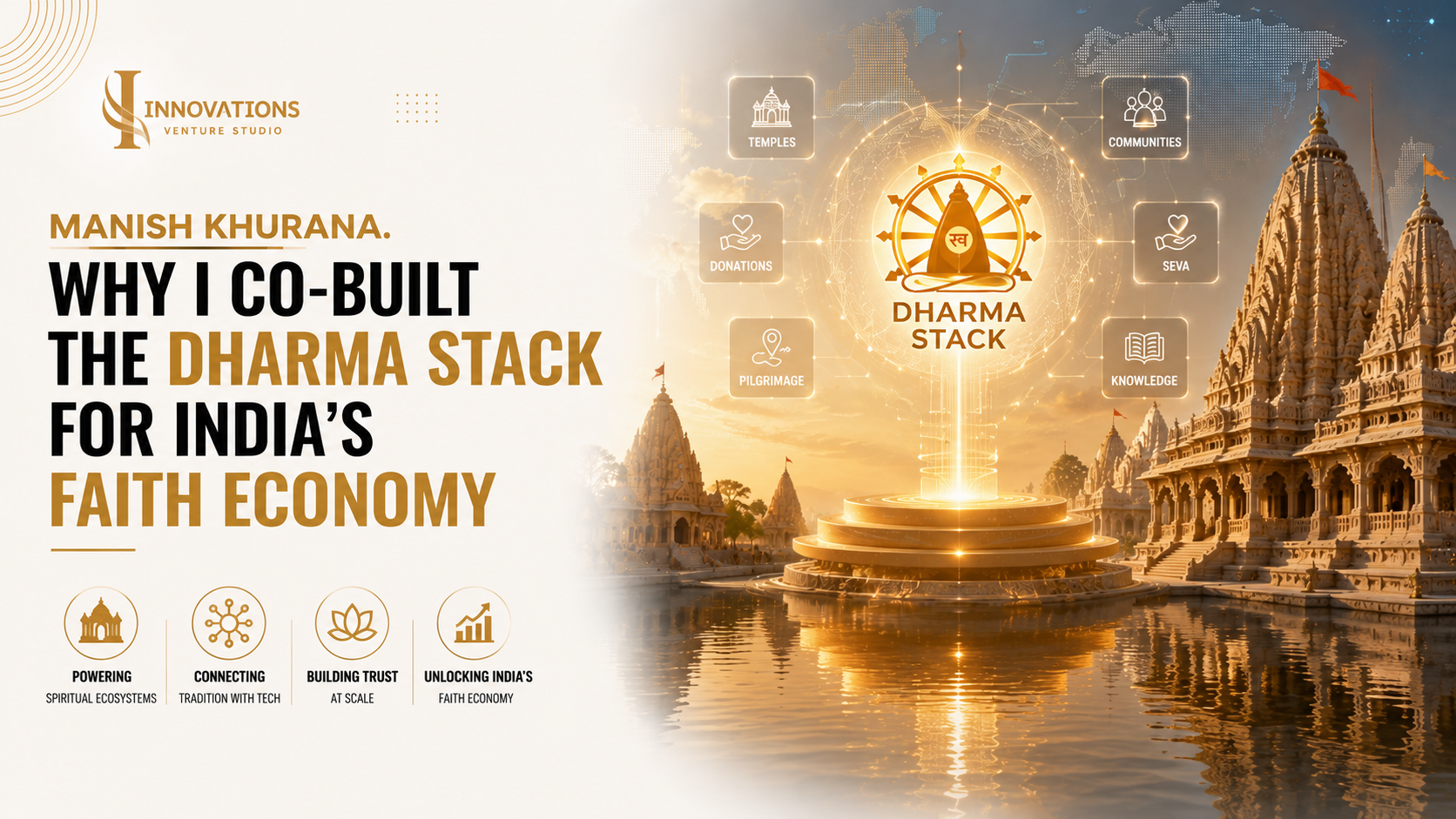
The primary solution we are creating is the “Dharma Stack”—a digital public infrastructure layer purpose-built for India’s religious and spiritual economy. Think of it as the UPI equivalent for faith institutions. By working alongside SwaDharma’s Co-Founder and COO, Pratyush Ambuj, my team and I are rolling out a robust platform.
Instead of just building an app, we are assembling three critical layers:
- SwaDharma Setu (The Infrastructure Layer): A secure foundation for payments and compliance sits at the bottom, managing daily operations and processing digital payments.
- SwaDharma ID (The Identity Layer): A unified, consent-driven identity layer sits in the middle, eliminating user friction.
- SwaDharma Mitr (The Intelligence Layer): An intelligence layer drives personalized spiritual experiences at the top.

Why Passive VC Capital Fails Here
Most traditional venture capitalists act as passive check-writers. They fund a startup, wait for quarterly progress reports, and hope the founders figure out the operational nightmares of entering an unstructured sector on their own. I have seen this status quo fail repeatedly because faith-tech requires institutional trust and significant operational legwork at the ground level.
When you provide cash without operational guidance, startups burn through capital trying to navigate complex compliance norms, local vendor networks, and outdated municipal regulations. Financial capital alone cannot build an ecosystem.
Building for Bharat’s Distributed Economy
This partnership highlights my core thesis at IVS: building for “Bharat’s structural economy.” These are the distributed, trust-dependent, and compliance-lagging sectors that actually move and transact every single day, yet remain peripheral to the mainstream venture capital narrative.
Startups navigating the complicated faith economy alone face hidden transition costs: unexpected legal roadblocks with ancient temple trusts and thousands of wasted developer hours. By co-building the Dharma Stack, Innovations Venture Studio absorbs these exact friction points. My model accelerates time-to-market and drastically reduces the financial cash burn typically associated with endless trial-and-error in a legacy sector.
My Vision for India’s Digital Infrastructure
India’s faith economy is not sentimental; it is structural. It is one of the largest pools of community trust and recurring economic activity in the country. The digitalization of this economy requires significantly more than superficial mobile apps; it demands robust, scalable infrastructure.
Through Innovations Venture Studio, I am proving that a hands-on, venture-building approach is the true key to scaling complex systems like the Dharma Stack. Products can be replicated, but infrastructure becomes defensible. If you are finally ready to build foundational tech that permanently transforms legacy sectors, it is officially time to look way beyond passive capital.