
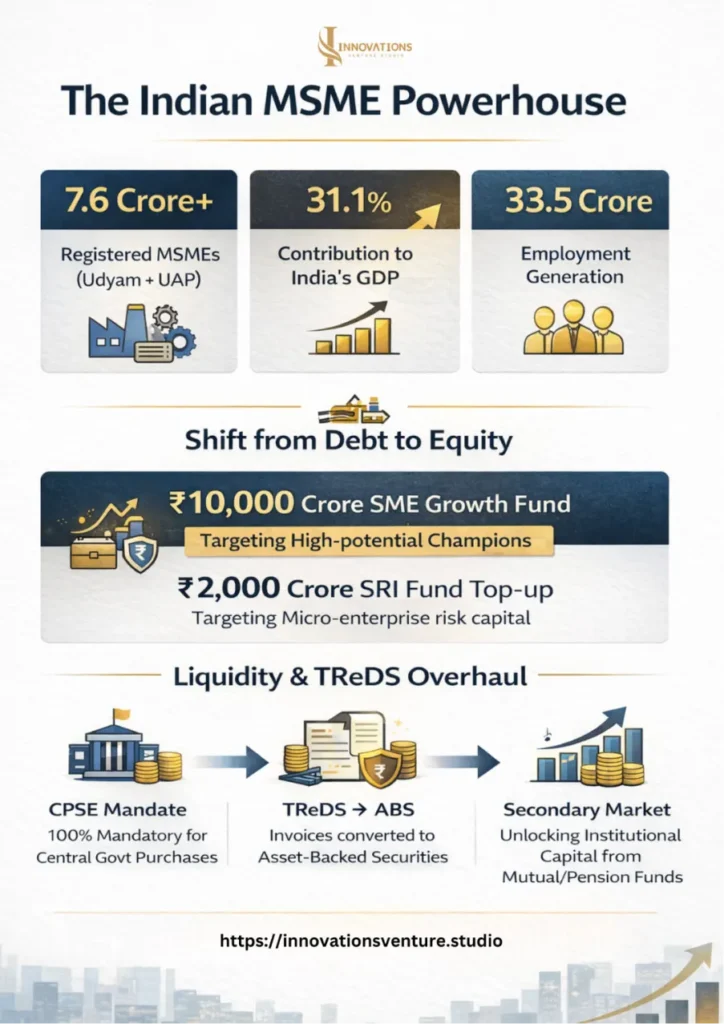
The Union Budget 2026-27 has arrived with a decisive message: India’s march toward ‘Viksit Bharat’ will be built on the foundation of its Micro, Small, and Medium Enterprises. With over 6.8 crore registered MSMEs contributing approximately 31% to India’s GDP and employing more than 33 crore people, the sector’s vitality is non-negotiable for achieving developed nation status by 2047.
Finance Minister Nirmala Sitharaman’s announcement of a ₹10,000 crore SME Growth Fund represents more than fiscal allocation—it signals a fundamental recalibration of how India approaches enterprise development at scale. For venture studios, early-stage investors, and MSME founders navigating the growth trajectory from sustainability to scalability, this budget presents a watershed moment.
Capital Infusion-Bridging the “Missing Middle”
The Budget 2026-27 tackles the critical financing gap where businesses are too large for microfinance but lack the collateral for traditional corporate loans.
₹10,000 Crore SME Growth Fund: Equity Over Debt
- Performance-based capital allocation: This fund provides equity support to MSMEs demonstrating genuine scalability and innovation potential, moving away from collateral-based lending that has historically constrained asset-light businesses.
- Patient capital for sustainable scaling: Unlike high-interest debt that burdens cash flows, equity infusion allows founders to invest in infrastructure, talent, and market expansion without immediate repayment pressure.
- Graduation pathway: The fund creates a structured route for small businesses to transition into mid-sized and large-scale operations, addressing the growth plateau that traps promising enterprises.
₹2,000 Crore Self-Reliant India (SRI) Fund Top-up
- Risk capital for early-stage expansion: This top-up ensures micro-enterprises maintain access to critical growth funding during vulnerable scaling phases.
- Complementary financing architecture: While the SME Growth Fund targets established scalable businesses, the SRI Fund supports early-stage manufacturers and deep-tech ventures requiring patient capital.
Strategic Implication: For MSME founders, the focus shifts from managing survival cash flows to managing valuation, governance structures, and strategic scaling—a fundamental transformation in financial planning
Enhancing Liquidity-From Delayed Payments to Instant Cash
Delayed payments from large buyers and government entities have historically strangled MSME growth. The Budget introduces structural reforms to solve this chronic problem.
Mandatory TReDS for All CPSE Purchases
- Predictable cash conversion: The Trade Receivables Discounting System (TReDS) mandate ensures verified invoices translate into immediate liquidity, typically within 3–5 days instead of 90–180 days.
- Auction-based competitive financing: Multiple financiers bid to discount invoices, ensuring MSMEs access the lowest possible interest rates through market competition rather than opaque relationship-based lending.
- GeM integration advantage: Seamless linking between the Government e-Marketplace (GeM) and TReDS enables faster verification and fund disbursement against government orders.
Tangible Impact on Operations
- Working capital liberation: Cash conversion cycle improvements of 60–75% allow MSMEs to accept larger orders without liquidity constraints.
- Supplier negotiation power: Immediate payment capability enables better supplier terms and volume discounts.
- Growth capital redeployment: Freed-up working capital can be redirected toward expansion initiatives rather than bridging payment gaps.
Debt Management Revolution-Creating an Asset Class
The most sophisticated innovation in this Budget is the development of a secondary market for TReDS receivables as Asset-Backed Securities (ABS).
Securitization of MSME Receivables
- Institutional capital attraction: Packaging verified invoices into tradable securities brings mutual funds, insurance companies, and pension funds into MSME financing—previously the domain of banks and NBFCs alone.
- Capital recycling for lenders: Banks and NBFCs can sell receivables to institutional investors, freeing their balance sheets to lend to more MSMEs, expanding overall credit availability.
- Risk distribution advantage: Professional investors across the market absorb risk instead of concentrating it on single bank balance sheets, creating system-wide stability.
Direct Benefits for MSMEs
- Reduced cost of capital: As the secondary market matures and deepens, discount rates on receivables are expected to decline due to increased capital supply and competition.
- Flexible debt management: MSMEs gain optionality—choosing between immediate discounting, direct payment collection, or using receivables as collateral based on specific growth requirements.
- Transparent pricing mechanisms: Standardized pricing based on counterparty credit quality and market conditions replaces opaque, relationship-driven lending decisions.
The ₹10,000 crore infusion and TReDS reforms provide the fuel, but your strategic framework remains the engine. Capital availability does not guarantee scaling success—it requires robust unit economics, operational excellence, clear market differentiation, and leadership capable of executing rapid expansion without proportional cost escalation.
The entrepreneurs who will maximize this budget are those who view capital as an accelerant within comprehensive strategic frameworks addressing market expansion, technology integration, talent acquisition, and operational efficiency simultaneously.
At Innovations Venture Studio, we bridge the gap between government policy and enterprise execution. We partner with MSME founders to navigate this new financial landscape—from leveraging equity funds to optimizing liquidity through TReDS—ensuring your business is positioned not just to grow, but to lead.
Is your business ready to become a Champion MSME?
Connect with us at Innovations Venture Studio today. Let’s discuss how we can partner to transform Budget 2026-27 provisions into your sustainable competitive advantage.