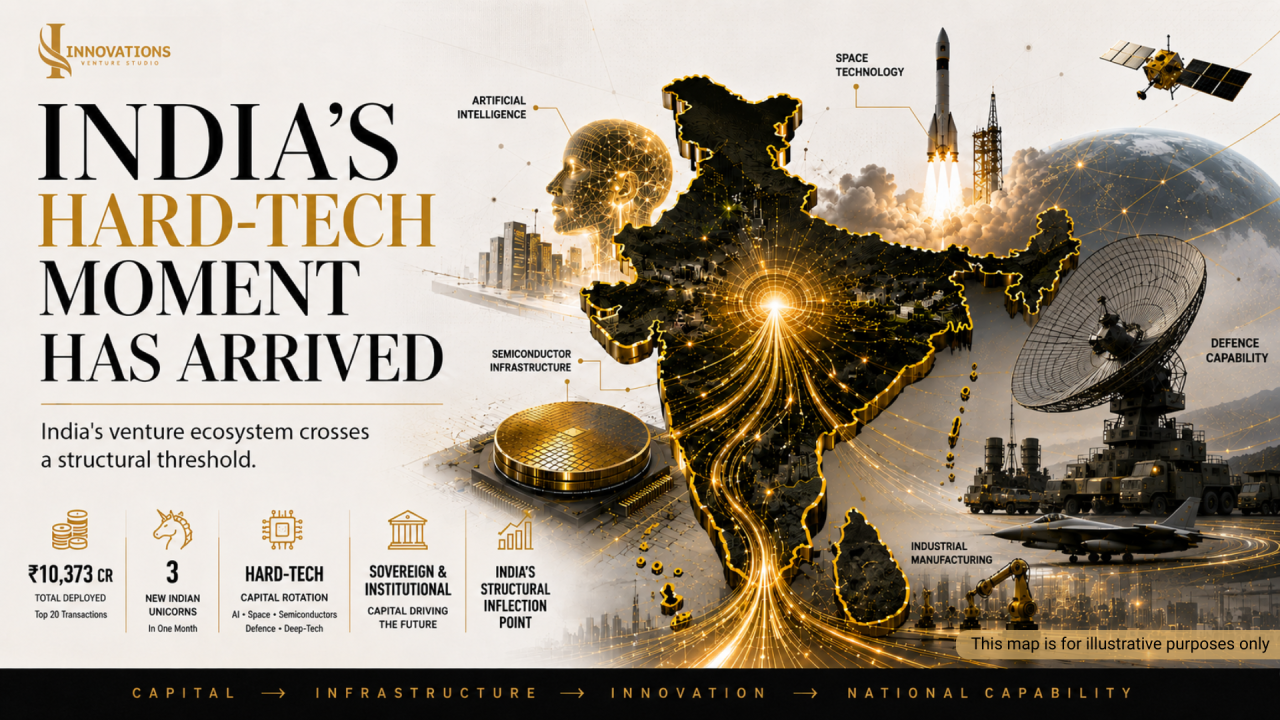


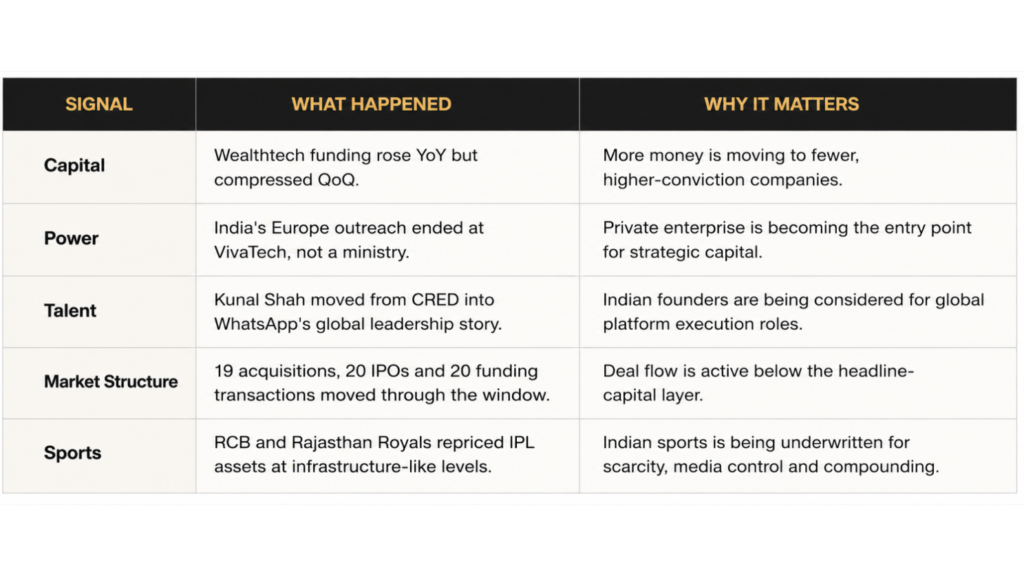
June 2026 was not defined by a single headline. Capital, policy, platform leadership and sports economics moved in the same direction at the same time.
Capital is concentrating. Wealthtech funding rose 84% year-on-year, but the market has not broadly reopened. Average cheque size hit a five-quarter high, and capital is moving toward businesses that resemble financial infrastructure, not discretionary apps.
Power is turning commercial. India’s Europe engagement closed at VivaTech, not inside a trade ministry. The Tata Electronics-ASML semiconductor agreement, alongside the wider incentive architecture, shows that state strategy now routes through private enterprise.
Talent is exporting upward. Kunal Shah’s move into WhatsApp’s global leadership orbit, alongside Meta’s investment in CRED, shows global platforms evaluating Indian founders for platform-scale execution not only India-market wins.

Opening Signal Panel

Currency note: USD-denominated disclosures in this section are converted to INR at an indicative ₹93/USD reference rate, shown as the lead figure with USD in parentheses, per IVS’s INR-first reporting standard.
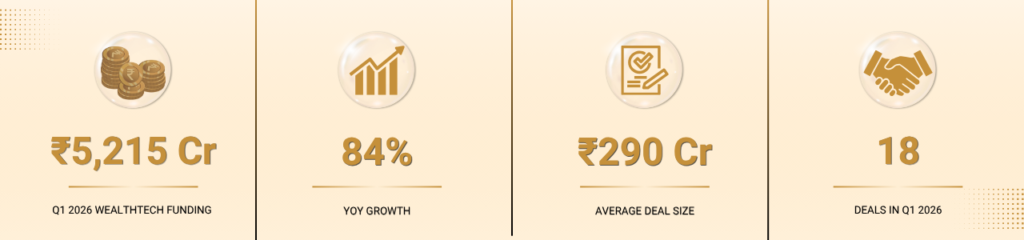
The Q1 2026 wealthtech story is not a broad market rebound. Capital is becoming sharper, more selective and more infrastructure-oriented.
Total wealthtech funding rose 84% year-on-year to ₹5,215 Cr across 18 deals. The sharper signal is average cheque size: ₹290 Cr, the highest level in five quarters.
Investors are not returning to spray-and-pray fintech allocation. They are concentrating capital behind fewer companies with clearer utility and stronger unit economics.
The category is shifting away from front-end consumer fintech narratives toward businesses that sit deeper inside the financial value chain. Wealthtech companies that show recurring usage, trust-led distribution, regulatory maturity and credible monetisation are now attracting disproportionate attention. Capital is rewarding platforms that resemble financial infrastructure not apps that depend only on acquisition-led growth.

A) Wint Wealth
Wint Wealth is a useful case because it represents category infrastructure, not consumer fintech. It expands retail access to corporate bonds and debt instruments historically reserved for higher-ticket investors.
Vertex Ventures SEA & India, Eight Roads Ventures, 3one4 Capital, Arkam Ventures and Zerodha’s Rainmatter fund backed the round. That cap table reflects conviction in the financial-plumbing thesis.
B) IPO Benchmark: Grow
Groww’s June 2026 IPO set the public-market benchmark for wealthtech quality: a ₹6,632 Cr issue, near 18x subscription, and a strong Day 1 listing.
At close, implied market capitalisation reached approximately ₹79,500 Cr, supported by FY25 revenue of ₹4,092 Cr and net profit of ₹1,916 Cr.
C) Kunal Shah and Whatsapp
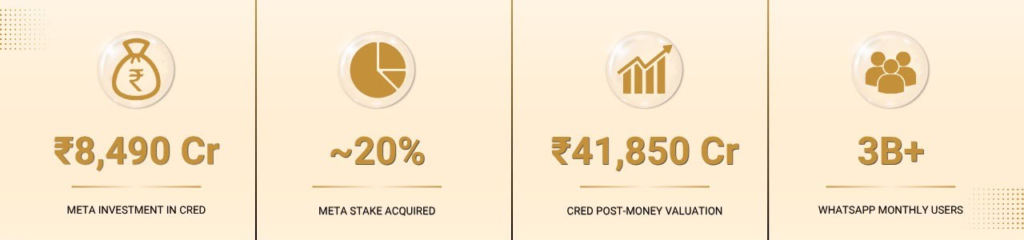
Meta’s reported ₹8,490 Cr investment in CRED, announced on June 22, 2026, is more than a late-stage fintech transaction. It signals how global platforms are starting to value Indian founder capability at platform scale.
The deal reportedly gives Meta an approximate 20% stake in CRED. It values the company at
₹41,850 Cr post-money, combining fresh capital with secondary purchases. Alongside this, Kunal Shah’s move to lead WhatsApp globally marks a real shift: global platforms are no longer evaluating Indian operators only for India-market execution. They are evaluating them for global product leadership.
The deal structure matters. CRED has no reported board seat for Meta, and no reported Meta access to CRED customer data. That positions the investment as strategic capital, not a data-acquisition play. It keeps the focus on capability, trust, distribution and platform adjacency.
For WhatsApp, India becomes even more strategically important. The country holds one of WhatsApp’s largest user bases. A fintech founder at the helm could sharpen WhatsApp’s roadmap around payments, commerce, business messaging and merchant workflows.
For CRED, the next phase is about operating depth: revenue quality, profitability, retention, and whether the brand can convert premium positioning into durable financial utility.
Strategic Read
The wealthtech sector is entering a more mature allocation cycle. Funding is available, but increasingly reserved for companies that can prove they are essential, not optional.
The winners in this phase will not be the loudest consumer brands. They will be platforms that become part of the financial operating system for investors, advisors, institutions and retail users. The real 2026 wealthtech question is no longer ‘Can this company acquire users?’ It is Can this company become trusted financial infrastructure?

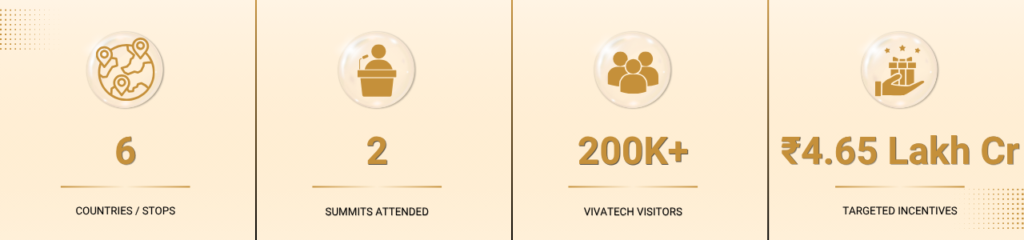
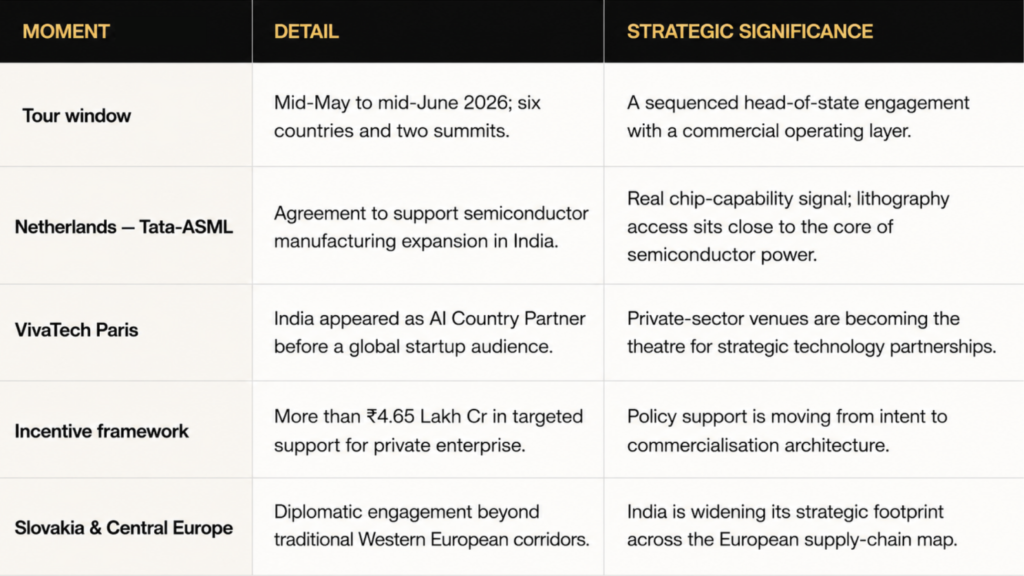
Between mid-May and mid-June 2026, India’s Europe engagement covered the Netherlands, Sweden, Norway, Italy, France and Slovakia. The arc was not ceremonial. It connected diplomacy, semiconductors, AI positioning and startup-market access into a single commercial sequence.
The most material transaction signal came from the Netherlands. Tata Electronics and ASML agreed to support semiconductor manufacturing expansion in India. ASML makes the lithography machines that make advanced chips, so this is capability-building, not symbolic diplomacy.

Strategic Signal Architecture


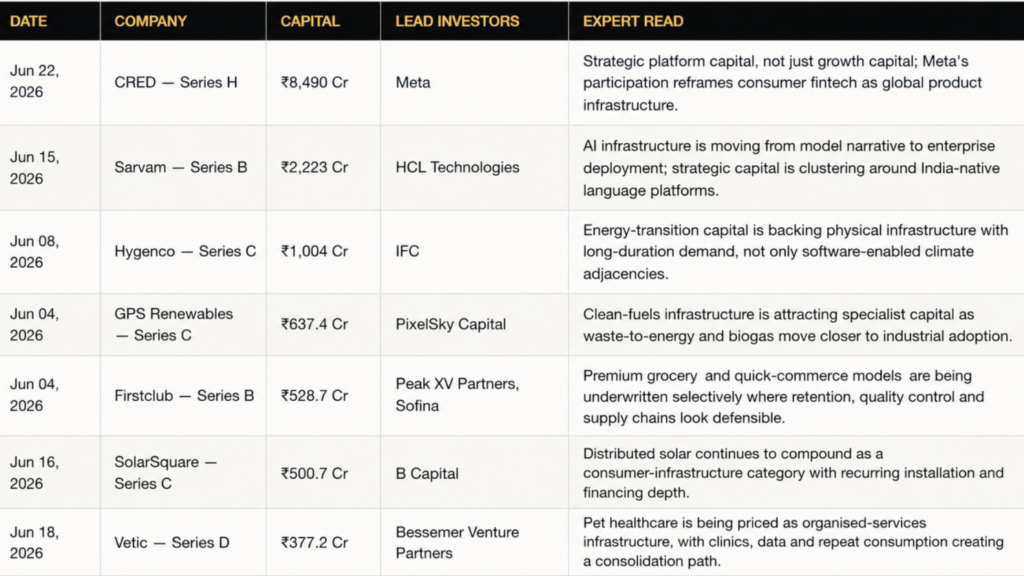
The market’s real activity sits beneath the headline layer. Funding remained selective but meaningful. Strategic acquirers bought capability, distribution and infrastructure. Public-market access stayed broad but concentrated in SME-board listings.


Top Seven Funding Transactions

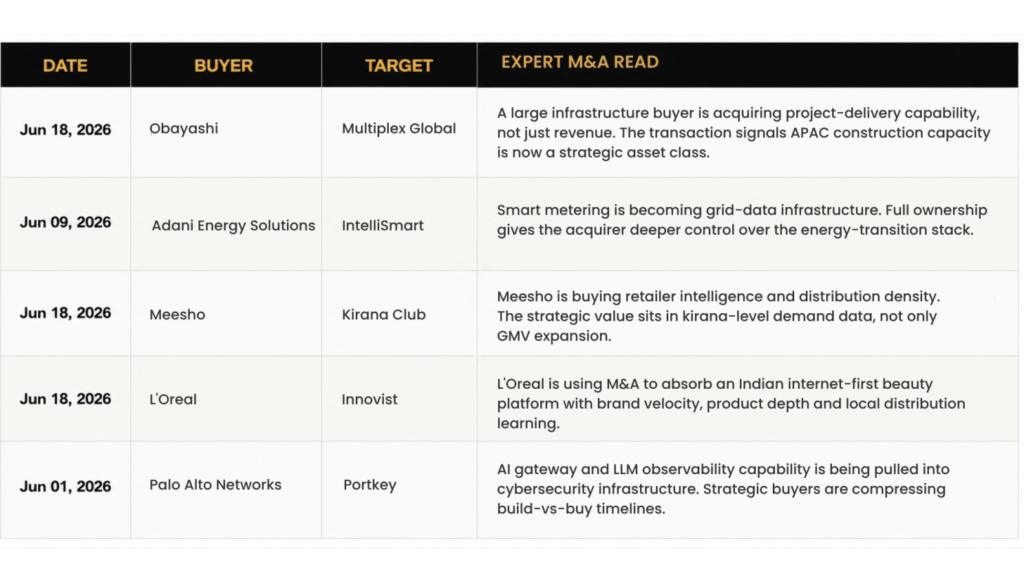
Top Five Strategic Acquisitions

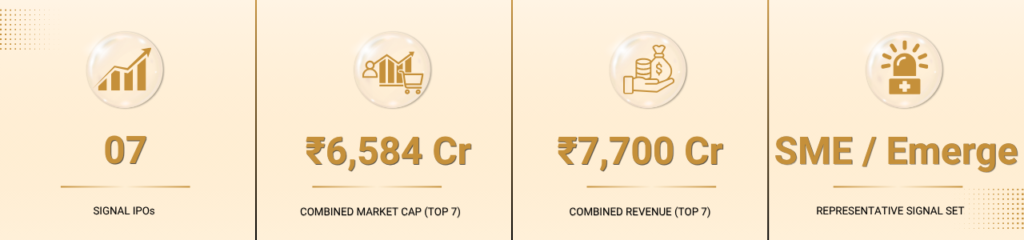
Public-Market Signal Set: Top Seven IPOs
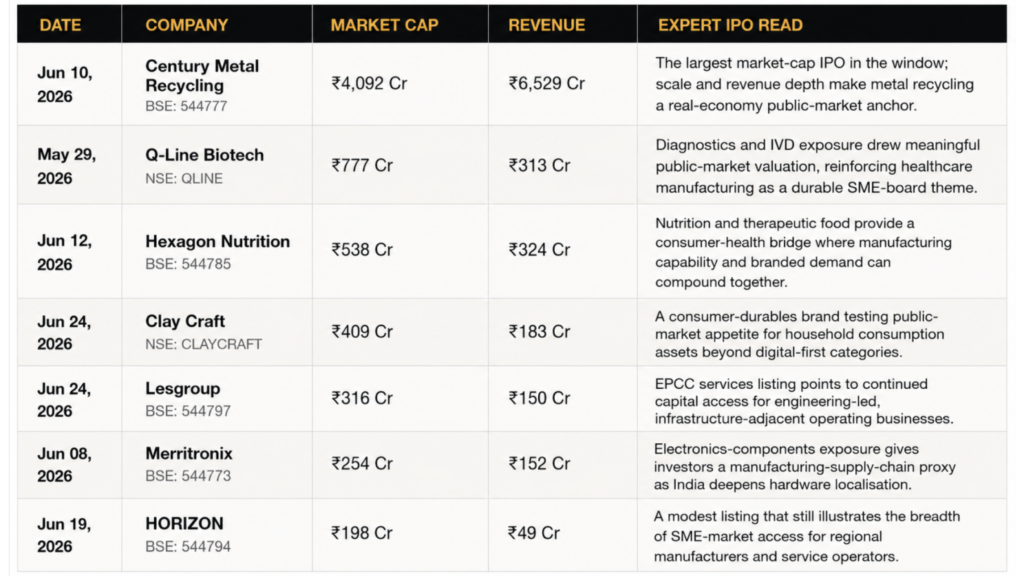
The table below presents a curated selection of the seven most significant SME IPOs during the period, chosen to reflect the strongest public-market signals across sectors rather than a complete listing of all issuances.


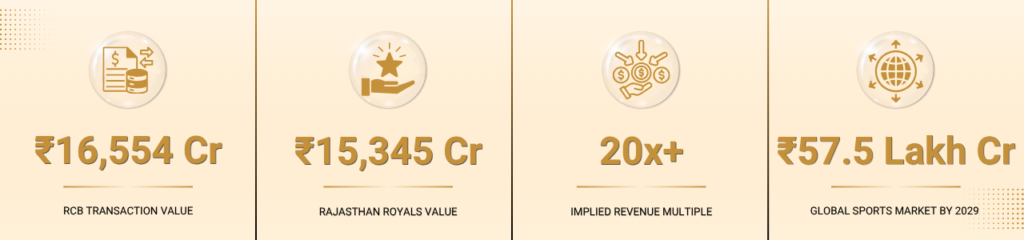
Two franchise transactions have accelerated the institutionalisation of Indian sports. RCB’s transaction at ₹16,554 Cr and Rajasthan Royals’ valuation at approximately ₹15,345 Cr together moved nearly ₹31,900 Cr of cricket franchise value in a single season.
The premium does not reflect short-term cash flow alone. Buyers are paying for ownership of scarce, regulated, nationally distributed media assets. That is why markets now value IPL franchises like infrastructure platforms, not traditional entertainment businesses.
Implied revenue multiples have crossed 20x+. The market is sending a clear signal: Indian sports assets are no longer passion-led holdings. They are becoming institutional capital assets, backed by media rights, sponsorship depth, digital fan engagement and long-duration scarcity.
For investors, the IPL is now a control-asset story. The opportunity sits in franchise ownership, media monetisation, merchandise, fan commerce, live experiences and the broader sports-infrastructure layer around cricket.
Strategic Read
Indian sports is moving from fandom to financial infrastructure. The next phase will reward operators who can convert audience loyalty into recurring commercial value across media, retail, data, commerce and live experiences.
Why the Repricing Is Structural
The global sports market is on course for ₹57.5 Lakh Cr by 2029. Sports franchises have compounded at roughly 13% annually over six decades, supported by scarce ownership rights, cultural loyalty, media contracts and increasingly professional governance.
India’s sports economy reached approximately ₹18,600 Cr in 2025, growing at 18.6% annually since 2021. The broader ecosystem media, merchandise, wellness and live entertainment — is much larger than the franchise line item alone.
The CVC Precedent
CVC’s Formula 1 playbook – rights consolidation, calendar expansion and governance discipline is instructive for cricket.
Its Gujarat Titans entry shows that global institutional capital is no longer observing Indian sports from the outside.




CricStudio is not just a cricket retail company. It is building a specialist cricket commerce platform that sits closer to participation infrastructure than generic sports retail. The company positions itself as a one-stop solution for cricketing requirements, combining quality equipment, custom player solutions, franchise-led access and ecommerce distribution across India and international markets. Its stated mission is to support every cricket player through verified quality goods, custom solutions and access to cricket facilities worldwide.
Portfolio Disclosure
CricStudio is an IVS portfolio company. This section is framed through an IVS portfolio lens as a practical example of how the studio is backing the participation layer of Indian cricket, beyond media rights, league ownership and broadcast-led value creation.
The model is structurally distinctive. CricStudio’s advantage comes from category depth, player-first product curation and a franchise-led retail network that allows cricketers to experience gear locally while still being supported by an ecommerce channel. Its differentiation is built around customisation, broad product choice, handpicked procurement and availability through a multi-city, multi-country presence.


At IVS, we track where capital, talent and market structure shift before they become obvious to the broader market. This month’s signals point to a clear pattern: capital is becoming more selective, strategic buyers are becoming more capability-led, and India’s operating talent is moving into larger global roles.
Challenging the Thesis
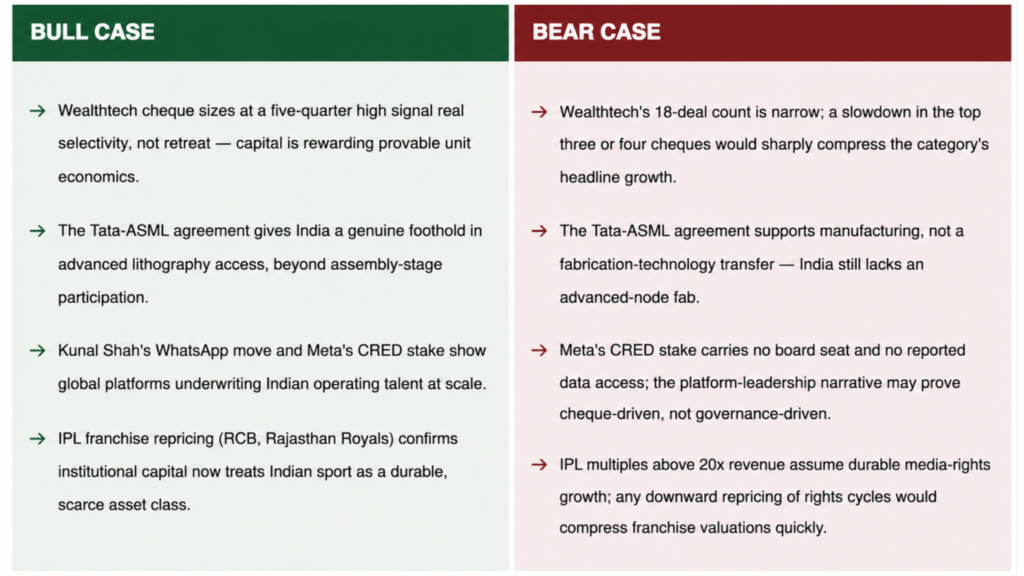
Risks & Alternative Scenario
- Currency and rate volatility could reprice cross-border deal structures – CRED, Tata-ASML – mid-execution.
- SME-board IPO concentration (100% of tracked IPOs) leaves public-market access narrow if SME-board liquidity tightens.
- Alternative scenario: if global rate cuts accelerate through H2 2026, capital could broaden back toward growth-stage consumer fintech, reversing this quarter’s selectivity trend.
IVS View
We read this month’s data as confirmation, not surprise. Capital, diplomacy and talent are all consolidating around control points: infrastructure, distribution rights and platform leadership. We are positioning portfolio companies to compete on defensibility, not velocity.
What We Are Monitoring Before It Becomes Consensus
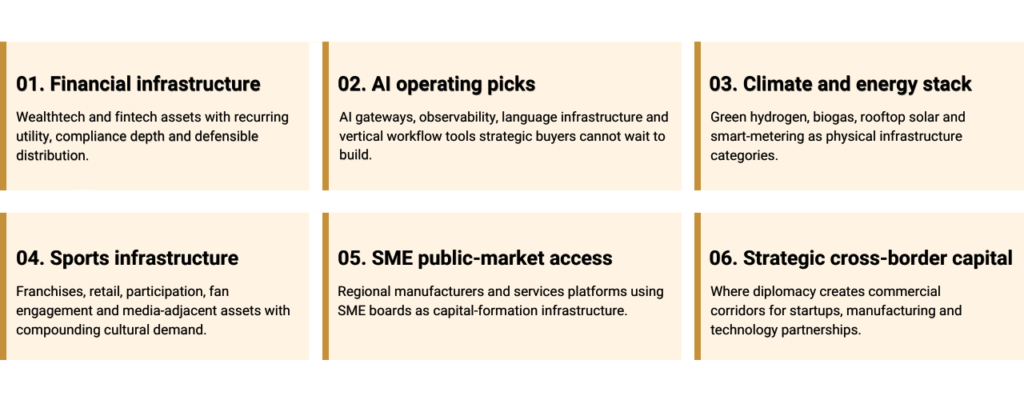


June 2026 does not resolve into a single market story. It presents a leverage map, and the operators who read it accurately will compound their advantage over the next cycle.
The common thread across wealthtech, diplomacy, talent, private markets and sports is control. Capital is paying premiums for ownership of scarce, hard-to-replicate positions: financial plumbing instead of consumer apps, lithography access instead of assembly capacity, platform leadership instead of local market share, media rights instead of passive fandom. Every signal this month points to the same underlying repricing.
This is not a retreat of capital. It is a redirection. The pool of available capital, diplomatic bandwidth and global platform roles has not shrunk; the bar for who gets access to it has risen. Founders, investors and operators who build toward defensibility, not just growth, are the ones this cycle is built to reward.


Sources and References
FinTech Global | TechCrunch | Business Standard | Bloomberg | WION | Yahoo Finance | GuruFocus | Meta | Tracxn | BSE | NSE Emerge | Outlook Business | The Tribune | CricStudio